


Community Circles Grant Access Program
If you have been interested in joining a Community Circle group, now may be your time. This donor-supported access grant covers a portion of the program cost to make leadership growth more accessible in our county. Please complete this form to apply for one of the available spots.
Community Circles is a small-group leadership development program rooted in connection, reflection, and real-world application. Designed to grow foundational leadership skills such as self-awareness, confidence, and purpose-driven action, the experience is both practical and transformational.
Group 1: Thursdays 9:00am-11:30am Sept 25th, Oct 23rd, Nov 20th
Group 2: Mondays 5:15pm-7:45pm Sept 22nd, Oct 20th, Nov 17th
More information on Community Circles here.
Effort & Happiness. A Ying to the Yang
You can call this a case for effort, sacrifice and suffering.
According to Arthur Brooks and Oprah in the book, Build the Life You Want, happiness and hard things coexist. They’re an amazing pairing of authors. Arthur Brooks is a Harvard professor, PhD social scientist, key note speaker, author and so on. Oprah, well, she doesn’t really need an introduction. They write about how long term happiness depends on things you and I may call features of unhappiness. The term happiness being different from the instant gratification stuff. It’s pretty well proven that instant gratification doesn’t lead to long term fulfillment.
When you listen to Arthur speak about his work, he offers up an equation to the good kind of Happiness to pursue. The type happiness that people at the end of their lives talk about. Below is my take on what his research presents.
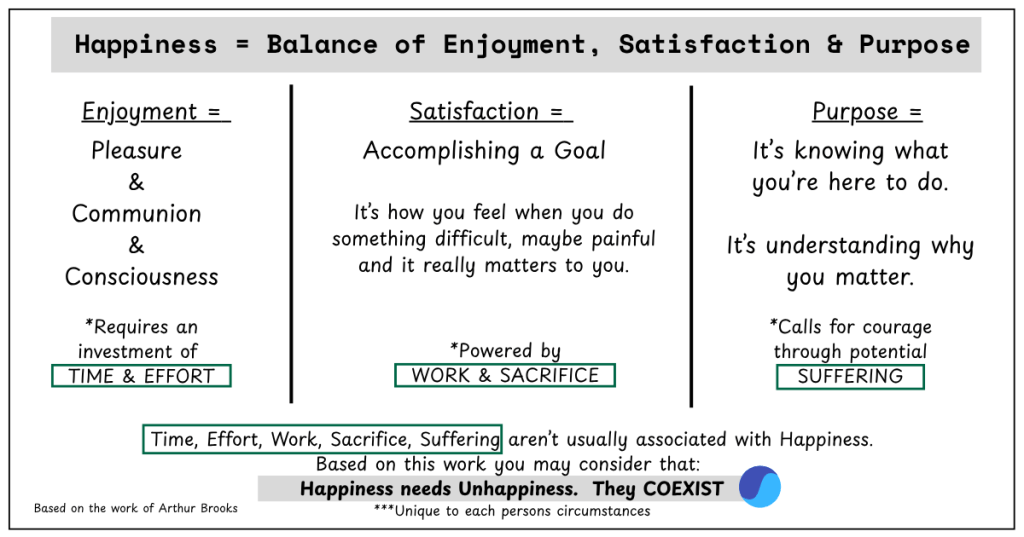
He says happiness is not a destination, it’s a direction. If he’s right in his equation and right that we can’t “be happy”, …we can “be happier,” then we have to consider how we add in these coexisting components that our brains usually shy away from.
Our brains get lazy, they want to stay cozy and comfortable just in case of a future event when they have to exert energy. The scientific term is the Default Mode Network (DMN). What Arthur is telling us tho is that we can choose a Task Positive Network (TPN). Choose to put in effort to plan with friends to do something together. We can set goals and pursue them fiercely. That probably means we have to clear our plates of other less important priorities. We can spend time understanding what drives us. Reflect on what our non-negotiables are and then use that coupled with our strengths to do the work we’re here to do.
The catch is THIS ISN’T EASY. And that is exactly the point. When we do/live ‘easy’ we may caught up in artificial, superficial, unnecessary blah. If we don’t have a focus, set our routines or our agendas, then other people may set it for us. If it be people we know or if it be the people we don’t know who live and make a living off our our scrolling and clicks on their pages or sites. (Irony noted, though no money is made via this newsletter)
An example here: it’s easier to go on a solo hike, walk or bike ride. It’s easier to eat a cookie by myself whenever I want than to wait for a planned cookie fest with friends. It takes zero thought, effort or planning to do something alone. Though it may be pleasurable to hike alone, we human gain more if we share the experience. Interestingly pleasure also ties directly into addiction and loneliness. Pleasure happens alone. Enjoyment happens when we take another step and share the moment, when we share a hike, walk, bike ride or cookie together, with others. We need to take Arthur Brooks’ advice and put the effort in to share things with others to get enjoyment.
There’s a lot that goes into his formula. Satisfaction being next to enjoyment. If you take a second and think about your biggest accomplishments in life, you may have had to sacrifice or delay things you’ve wanted. In fact, our brains may tell us it’s easier to live without goals, remember DMN? To drift. Doing the day to day.
It takes courage to stretch towards a different future. To choose a path that’s different, to set goals. It takes vulnerability to get specific on what you actually want to experience or accomplish. Because you probably have to explain this to other people. That can be scary. And that is a good thing. Having support around you is good – sharing big things is good. When you set goals, it trims the excess fringe in your life. You may already know this or may be learning this: we can’t do everything. Goals can reduce unnecessary busyness and simultaneously increase focus. Goals are a gift you can give yourself.
Looking at the third part of the formula here, the piece of Purpose. A knowing as why you’re alive, who you’re serving and what you’d die for. At least that’s how Arthur says it. Big questions there. To make them smaller, what are the things that really matter to you? What gives you a lot of meaning in your life? There’s probably a strong correlation to what you really value is what you’re willing to suffer for.
A lot to think about. It’s easy to forget this when life gets busy, loud, and distracting. Purpose, satisfaction, and enjoyment are built…not given. They come from showing up for the shared stuff that requires effort: the insane bike ride we plan with friends, the goal that kinda terrifies us, the choice to be more intentional. This work is a reminder that effort, sacrifice, and even suffering aren’t obstacles to happiness—they’re part of the path, they coexist, the ying to the yang.
What areas are you putting in the effort, focused, sacrificing a little? Where are you opting out and hanging in the Default Mode Network?
 Hailee Rustad